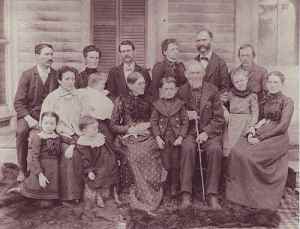
Tradition says that the founding of the Arnold family in America was by three Arnold brothers coming from England at an early date. One settled in Massachusetts, one in Connecticut and one in Rhode Island. Ours was the Rhode Island branch. Henry Dennis Arnold my grandfather was born there, as also were his brothers and sisters. I have no knowledge of any of them besides my grandfather except that I know he had a brother William, who married and came to the eastern part of York state.
March 19, 1901
Looking Left to Right Back row – Uncle Vern, Aunt Ida & Anna with Uncle Frank, Aunt Hannah & Uncle Ed, and Alonzo Graves. Front row – Aunt Mary (Vern’s wife) with Gladys (left) and Adeltha (right), Drusilla, Roy (Franks Son) Robert Arnold, Nellie, Emma
Henry Dennis Arnold and his good wife Desire Ellis (also born in Rhode Island) were married and had three children born them (Augustus Ellis, William Slocum and Sally Alice). In 1824 they moved to York state, stopping first in Chenango Co. where Robert Bell was born. After living there for three years they removed to the adjoining county, Otsego. Morris was the village and post office near there. It was called Lewisville then. Here the parents spent the rest of their lives. Here also Henry Dennis Jr. was born, also the twins (Celinda Miranda and Lucinda Matilda) and Charles Edwin. Fourteen children were born to them, but only those whose names are mentioned, lived to grow to maturity.
They settled on a small farm where there was a sawmill beside a pond to furnish power to run the mill. They eked out an existence on a small scale by farming and running the mill with the boys helping as they became old enough. Grandma developed quite an aptitude for nursing, and became quite an expert midwife and was very useful in illness all about their neighborhood. It got so she was sent for, for miles around. Every autumn she made it her business to gather great quantities of “yarbs” as she always called them – sage, hops, wormwood, catnip, pennyrile, smartweed, boneset etc. She had a small room in their chamber, exclusive to keep them all hung around in paper sacks. When sent for, she always took along such “yarbs” as fitted the case. She was great on “physic and sweating”. There were those who still sent for “Aunt Desire” after she was too old and feeble to go out. In those early days she would be gone days at a time, her girls doing the work for the family. Grandma was a fine housekeeper considering what they had to do with, and her daughters were taught to be good workers too.
Grandpa was a hardworking law-abiding citizen. Strictly temperate in all things, a quiet man, no talker. He was never of the sort to interest his children with tales of his childhood and home or family, so I suppose that is the reason why so little was known and handed down of his early days. It is really too bad.
Grandmother was a great talker (my folks said I should have been named ‘Desire’). Grandma was a well-posted woman of the general news and topics of the day. They took papers so she was well read. She was a strong “spiritualist”, and stuck to it till her death. She talked to me so much of her people, of who they were, their traits of character, where they lived etc., so that I know more about the Ellis family. And I knew so many of them too. Two of grandma’s family, a brother and sister and their families came at an early day to Willett, Cortland Co. NY. The brother was Augustus Ellis and wife Martha. His children were, Allen Charles, Martha, Olive, Sarah and Mary. They settled about two and half miles east of Willett Village, on a farm by the roadside that bordered on a pond of several acres. The pond was named “Ellis” and has held to that name to this day. Father bought his first farm across the road from his Uncle and it bordered on “Ellis” pond. The house my folks lived in is still standing, but Uncles house is gone.
Mother said she loved Aunt Martha like a mother. She was such a help to mother in many of the little problems of a new housekeeper, was with mother at the advent of the first three babies. There things all count. The Ellis’s finally moved on over to Madison Co. near Dewyter Village. Sons and daughters all married raised families. They were very bright excellent people. Grandma’s sister who came to Willett was Aunt Polly and her husband Altitions Burlingame and all their sons and daughters; Altitious, Wescott, Pardon, Augustus, Charles and Almira and some I have forgotten. They built a log house first and all their children married right around there and settled in and around Willett. I knew and visited them all. They were a good race, some of the grandson’s were exceptionally bright, taking high stands among the men of the day – ministers, lawyers, doctors, teachers, merchants, house builders, mill wrights etc. All gone from Willett now accept three great grandchildren (John Wescott Jones and Mina Burlingame Pember and Mary Burlingame Cole)
Augustus Ellis, the oldest son was a hard working boy, and a studious only devouring everything along the educational line he could get a hold of in that early day. He was a beautiful penman; I have some of his writing. He would have taught school, but consumption developed when he had just reached man hood, and his career was snuffed out ere it had begun. Father always regretted his death very much. He always said, “Augustus was ‘cut out’ for a man who would have been heard from.”
The second son William Slocum worked at home with his father longer than the rest did, but finally he married Susan Swarthout of Morris, settled there for a while, then pulled up stakes and journeyed to Davenport Clinton Co. Iowa, farmed it there for a good many years, returning to York state to visit his mother and other kindred at three different times. The first time was in 1866, again in 1871 and again I think in 1878 or 79. Finally he developed rheumatism in its worst form, thought a change of climate would be a benefit to him. So he took a trip to Missouri to see the prospect there. No Good! Went back to Iowa and took another start. This time to Maryland, bought a small farm near Codova Talbot Co. Maryland. In all these trips that I have recorded he couldn’t walk a step and had to be carried on and off of trains. Aunt Susan was with him of course. They went back to Iowa, superintended the packing of their goods, sold the farm, bid good-bye to Iowa forever, and went back to their new farm in Maryland. The farm was a fruit and vegetable farm and they raised lots of sweet potatoes. He hired a man, helped a good deal and their adopted daughter Lettie, did all the rest. Father went down to visit them in 1883 and in 1884 brother Edwin went down. They reported Uncle William as being a most pitiful object, for eighteen years before he died he couldn’t walk a step. He died in 1899. Aunt Susan with Lettie’s help cared for him faithfully till the end. Aunt Susan died in 1903. Lettie died in 1931.
In 1846 Aunt Alice married Charles Giles Burlingame Jr. who was a son of her own cousin Rev. Charles Giles Burlingame Sr. They bought a farm built a house and barn, called the place “Sunny Nook”. It was a mile from Willett, East across the creek off from the highway. They kept bees and Uncle Giles built a long shelter for them, erected a flagpole where Aunt Alice used to unfurl a good-sized flag in pleasant weather. A large peacock strutted on the green lawn, a large white dog graced the place and it looked very attractive. Aunt Alice was an excellent housekeeper. In my little girlhood I went there many many times with my mother, but I’d rather go anywhere else. Aunt Alice was a very stern severe woman when children were around. Always telling how her children would obey if she had any. I was always glad she didn’t have, for they would have been miserable. Uncle Giles died in 1862. I was too young to remember him. Aunt Alice undertook to do the work on the farm with the help of a young boy who went to school. She used herself up in spite of all my father or the neighbors could say, she was so obstinate, and in 1864 she died, following him in about two and half years. They united first with the Methodists, and then with the Presbyterians, and then she became a spiritualist. Then she denounced that bitterly and died an Episcopalian!
Robert Bell worked at home and went to school but little. He went to church every Sunday after he was old enough, to pump the pipe organ in the old Zion’s Church at Mossie; it took two boys to pump it. They got 25 cents apiece every Sunday. When he was twenty-one years old he took his way on foot to Pennsylvania to work at carpenters trade. He had his extra shirt and socks tied in a red handkerchief. He found plenty of work in barns, bridges, wood mills etc. He found a good carpenter to work for and was employed by him for four years.
He found Mother there at Honesdale Wayne Co. Pa, became acquainted in 1851, were married and went to Willett on the farm he had previously been up to and bought. Here Edwin, Mary and Clemma were born. After 6 years they sold out, rented rooms of a neighbor and father hired out to a hardware man to peddle tin. He ran the cart for a year then rented a large farm near Willett village. He had a good dairy and speculated in young stock and horses. He made pretty well at it. But while they were there, diphtheria came in that section and took the two little girls. They died in May and a new little girl came to them in July. In 1863 they left the farm and bought a house and lot down in Georgetown, a little settlement a mile above Willett. While there Father engaged as a clerk in Binghamton NY for a year. Then he was appointed Deputy Provost marshal to take care of the drafting in our county in the Civil War.
In the early part of 1865 he had the estate of Aunt Alice to settle up, and after that father, mother, Edwin and I went West to Michigan to visit mothers people, and father went on to Iowa to visit his brothers William and Dennis. We were gone from home 2 months. In the Spring of 1866 father bought a farm of 30 acres in town of Triangle Broome Co. NY and the first of April we moved there. Father worked the place with Edwin’s help and worked at carpentry a great deal. In 1867 Devern was born and in 1872 Frank was born. Edwin went to Whitney Point to the Academy and graduated, and was valedictorian of his class. I went to school in our district summers and winter for 10 years, then to Whitney Point for a time. Edwin taught a good many years.
In 1877 father bought a large farm of 184 acres 2 1/4 miles farther up the road. Father worked very hard and put the place in good shape. Edwin taught school winters and worked at home between times. In 1885 Edwin married and went down to live on the other place. I was married before that but lived at home a great deal as mother needed me. In 1889 my husband rented a farm in our neighborhood and we were working hard when my husband Salma, was taken suddenly sick of appendicitis and died in one week. He was not operated on as the disease was new then and operations for it were unknown. Then I took my daughter Dessie and went back to my father’s house.
In 1892 I married Alonzo C. Graves and went to his home on the Otselic River a mile below Upper Lisle taking Dessie with me. In 1893 Nellie A. was born, and in 1895 Edward Robert was born. In 1896 both the babies were taken deathly sick of “cholera infantum” and Edward R. died. In 1897 Dessie had measles that were followed by diphtheria and died. She is buried in Lisle cemetery beside her father. In 1901 my husband Alonzo C. died of cancer. Then I took Nellie and went back to my father’s house again. What a refuge it was. In 1903 I was married to Lyman West of Binghamton and went there to live. Nellie went there to school. In two years we were induced to rent the large dairy farm of Mrs. Dye at Sanitaria Springs, 12 miles away. Here we lived 4 years working hard. Then the owner died, and the farm was sold. Then a large farm was offered to us near Whiney Point, so we went there in 1909. The owner of this farm died and the farm was for sale. We bought it and here we are, but we are both done working – now just “waiting”. But we enjoy talking over the work we have done, dairying, making butter, market, gardening, general farming, taking summer boarders, also entertaining a great deal of company.
Lyman’s son who was only 4 years old when I came in the family, has always lived at home and runs the farm and a hired girl is kept the year around. In 1908 brother Edwin’s wife died and he lived alone for some time, finally he boarded at his sister-in-law’s where he died in 1919. He was brought to my home where the funeral was held. How I missed him. He was a second father to me. Devern H. was married in 1889 and rented a farm over East in the next school district. After a few years he bought it. He had a large dairy and did general farming till his wife was stricken with cancer and died in 1901. She left two little girls. Brother Edwin and wife took the youngest to their home to care for. Devern kept the other and hired a woman to do his work.
In 1893 Frank was married and took his wife home and ran the farm. Father bought a smaller farm of 55 acres a mile down the road, where he and mother went to live. After working the little farm with some help from the boys who all lived in easy distance from him, for seven years, his health gave out and 1901 in the Fall. Vern having let out his farm took his one girl and went over to fathers to live. It was then that Nellie and I went too. We said went home to have our parents finish bringing us up!! It was in 1903 after I went away that father and mother both died within 11 days of each other. A few weeks after this Vern was married to a schoolteacher. And what a good mother she was to those little girls. They cannot remember their own mother, but they will never forget the loss of one of the best stepmothers that ever lived. Vern sold the small farm and went over on the large farm to live. Here they lived working hard, the girls went to district school till the oldest one graduated at the Whitney Point High School. Then on to the Oneonta Normal School where she took up teaching for several years, married in 1917 went to farming, and a little son was born in 1923.
In 1925 we had shortage of teachers and the county superintendent urged Gladys to take up teaching again. So she did teaching in their own district near home, and she has taught every year since. They bought a new farm over in Tompkins Co. She was teaching when they moved this Spring. They were just out of a teacher where they went, so it was quickly arranged with the superintendent to get another teacher where she was teaching, and she got to the new school with only the loss of a week. The other girl married, bought his mothers farm and are busy farming. No children. Frank and his wife Ida were very successful farmers, raised their boy and girl, all great workers. Then his wife went down in poor health and was sick all summer. While she was sick the boy and girl both married. She wished it so. Just as winter set in she died – 1915.
Anna and her husband stayed at home and helped his father till New Years of 1917 when he married Edith H. Burrows. Frank and Edith farmed it three years more then sold the farm and went to live in a home he bought in the city. Anna and her husband went to live on a farm of their own near by his people in Triangle. Frank worked several years in a large supply house where all kinds of farm machinery was sold. He had fun a good patron of the grange both he and his first wife, and the second wife was a great grange worker too. Then Frank was made a District Deputy of the county. In July 1929 Edith died after a long long time of suffering. In Jan 6 1932 he was married to Marian Chubbuck. He is in the real estate business at present. Frank’s son Roy was living on a beautiful farm in Groton, Tompkins Co. In Jan 1932 their home burned and nearly everything in it. A great loss to them. They are now living in rented quarters and he is working at carpenters trade. They have on child, a girl born in 1926. Frank’s daughter and family are living on a beautiful farm they bought over on the other river across the hill from us. They have three girls, all in school.
After Vern’s second wife died he ran the farm with the help of the youngest girl for one year, then in Nov 1917 he married Nellie Ballard a Whitney Point girl. She has her own home, so Vern went there to live. He is Deputy Sheriff and Assistant Mail Carrier, that covers 25 miles a day.
Henry Dennis Arnold Jr. was born in the town of Morris, Otsego County, New York state on March 12th, 1828. Mary S. Morse was born in Lawrence, Otsego County, New York on Nov 5 1828. Henry Dennis Arnold and Mary S. Morse were united in marriage at the house of Jesse B. Kenyon in New Lisbon, Otsego Co. NY on June 12th 1851 by Rev. L.C. Pattengill, minister of the Baptist Church. Witnesses were Jesse B. Kenyon and James L. Morse, brother of the bride.
Their children were: Duillius Henry Arnold, born in Morris NY June 18th 1854; Mary Emma Arnold, born on a farm near Malcom, Powshick Co., in Iowa on Nov 1st 1864. In the Spring of 1856 Henry Dennis Arnold went to the central part of Iowa, bought land, built a saw mill, sawed lumber and built a house and made other improvements, and in the Fall of 1857, moved his wife, boy and household goods by lake and railroad to Davenport, Iowa – then by wagon 125 miles to their home. The next year after arriving with his family, he bought two acres of land and moved his house to what is known locally as the “Yankee Settlement” on the state road over which the Wells and Fargo Stage line run between Davenport on the Mississippi River on the East, to Council Bluffs on the Missouri River on the West. The settlement consisted of the “Cardells, Meigs, Raymonds, Bates and Harveys – all down East Yankees and Yaples – Pennsylvania Dutch, and the Arnolds were called NY State Yankees.
Henry D. Arnold built a blacksmith shop on the state road, and did the work of the farmers far and near. During the “Pikes Peak” gold rush in 1859, he had all the work he could do working for the traveling public besides attending to his farm work. About the time he moved to Iowa, the old M. & M. R/R. was projected, and in 1866 it was built through Powshiek Co. about 2 miles from the settlement, and the town of Malcom was started, and is now the main line of the C.R.I.&P.R.R.
The family had all the experience of pioneers, hauling their supplies 120 miles, and only just what they had to have, which would not be much in this day and time. Pine lumber, windows, doors etc hauled more than 60 miles with ox teams, for the first schoolhouse. Most of the work done for free, and finished a little better than the common run, as it was used for a church for many years. Doctors were few and far between, and many a soul was born into the world just attended by loving and sympathizing neighbors, and many of their dead were buried without the benefit of a clergyman.
When the Civil War began, H.D. Arnold joined the first call, but was taken sick with inflammatory rheumatism. He was brought up the river to the government hospital at Keokuk, Iowa, and laid for more than 60 days unable to turn over. He finally recovered enough to be sent to Mt. Pleasant, Iowa, where he was discharged and sent home in a wagon after 16 months service.
In a few months he was able to do some work, sold his farm he first bought, and bought 160 acres adjoining his home, and kept the Post Office for several years, and was busy in his shop when he was able to work until he died – September 20th 1866. He was buried in the orchard near his home. About 10 years later was removed to the cemetery near Malcom. He died a consistent member of the Presbyterian Church. The funeral sermon was preached by the Rev. A.D. Chapman, Pastor in the schoolhouse that he had taken so much interest in building in the earlier years. He was a fine singer and led the song service in all of the meetings and social gatherings of a social kind.
Mary S. (Morse) Arnold, his wife had a full ;art in all these experiences common to frontier life. After the death of her husband, she was left with a boy 12 and a baby girl two years old. She still lived in the old home. By good management she paid the debts still due and lived a good Christian life, raised her children in the fear of God as best she could, and was helpful to everyone she came in contact with, did her full part in caring for the sick, helping to prepare the loved ones for burial, washing, dressing and making clothes, act the part of the good Samaritan in all things. When she passed out of this life many there were who called her “mother” and “auntie” and other loving terms. Perhaps her outstanding characteristic, was her honest in all things. Many the time when they were undecided as to the propriety of something in regard to the church or its method of raising money, that she would ask; “Is it right”? and if assured that – all was right, it met her approval, and if not right, was condemned and other ways provided. She passed away July 5th 1896, and was buried beside her husband in the cemetery near Malcom.
Duillius Henry Arnold, the only son was three years old when he went with his parents to the farm in Powshick Co. Iowa. He was a frail sickly child unable to attend school until his tenth year. When he was 12 years old his father died. He was not old enough to work the farm, but raised some feed, worked some for the neighbors, and helped his Mother as best he could until he was sixteen years old, when with the assistance of a hired man about 8 months of the year, he worked the farm until he was 26 years old.
In 1880 he was married to Miss Mary Gertrude Hilliker in Davenport, Iowa where Miss Hilliker was born and raised. Duillius brought his bride to the farm, and the Mother and sister moved to Malcom so sister could have better school opportunities. On June 25, 1881 a son, Austin Duillius Arnold was born. January 1, 1882 they moved to Malcom where he worked for the C.R.I. & P.R.R. Co. After that he engaged in the butcher business, also buying selling and shipping hogs and cattle on the markets in Chicago and other places. Here four more children were born; Lillian M. 1853, Hanson V.1885, Clara E. 1887 and Flora G. 1889.
On Sept 11, 1888 being attracted by the cheap land in the Pan Handle of Texas, Duillius went hither, arriving in Hall Co, Texas, September 14, 1888. His first stop was at Salisbury, Hall Co. which place consisted of two small box houses of two rooms each, and a small depot, which the agent a single man, occupied as R.R. and express agent. Many pages could be filled with the experiences of living in a new country, and this country was different from any other country, as the state of Texas retained her public domain when she was admitted into the union, and had had many laws passed in order to get people to settle the land.
The fort worth and Denver city R.R. had completed the road from Fort Worth, Texas, to Denver Colorado, about 850 miles, and most of the way unsettled. The cowman was the principal business man of the country. Many parts of the country had freighted their goods from Fort Worth , Texas , or Fort Dodge or Dodge City Kansas . Every thing was high, and no money to buy with. The land at this time was selling for $2.00 per acre, 1 forth cash and the balance on 40 years time, and 5 per cent interest.
D.H.(Duillius Henry) Arnold selected a section about a mile from the switch on R.R. which was called Newlin, built him a cabin and as he had a desirable piece of land, he thought he was doing pretty well, but there was no neighbors nearer than four miles. The only thing to do was to work as a cowboy, which he did until the spring of 1892. Soon settlers began to come in around the little place called Salisbury, and in 1889 a town was started on the R.R. 4 miles north of Salisbury, and became a rival candidate for county site, when the county should be organized, and about the same time in 1889, a store was built in Newlin, and settlers came in there. The county was organized in June 1890, and Memphis was selected, 4 miles north of Salisbury . In the spring of 1892, he q2uit cowboy life, built him a pretty good house, and his family arrived from Iowa with a car of household goods and moved in the new home on September 3, 1892. On September 3, 1898 the whole thing, house and most of the furniture burned to the ground. Those who remember the financial condition of that time, can imagine the result. In June 1894, they moved to Estelline just across the river south, a town which had been started about a year. They were the third family in town. He worked on ranch most of the time until 1900, when he moved to the county seat, Memphis, where he was Deputy Sheriff and tax collector for tow years then bought drag line and water wagon which he run for sometime, and in connection with other work, was County Treasurer for 4 years, then he engaged in butcher business, trading in cattle, shipping them to Kansas City, Oklahoma City, Fort wroth and various places. He finally drifted into a market which he conducted for about 20 years. In November 1924 he went to hospital in Dallas , where he had a serious operation. After three months was sent home just skin and bones, with but little hopes of ever having any health again. But to the surprise and gratification of his many friends, he regained a portion of his health and strength, but had to sell his business, and his friends elected him in 1926 to the office of District Clerk, which office he stills holds.
D.H. Arnold was raised by a Christian mother and under the influence of the church, joined the Presbyterian Church early in life. There being no Presbyterian Church in his Texas home, joined the Methodist church, when the family came, all went there until after the Union of the U.S.A. when a Presbyterian Church was built, then all joined there except Lillian, who had married into a good Methodist family.
D.H. Arnold was superintendent of the S.S. at Newlin near where he first settled, was later first S.S. supt (?) in Estelline, also one of the Stewards. Served in the same office in Memphis M.E. Church , and then when united with Presbyterian Church, was elect one of the trustees and elder. He is also an F. and A.M. having joined that fraternity years ago in Iowa . He has gone up step by step until he became a 33’d degree Mason. And a very true devoted member he is too, attending all the different lodges for miles around when ever he can, even now in his advanced age he keeps in touch with everything that pertains to Masonry or church.
His family are all musical. As mentioned before his father was a fine singer, a ready reader of music. He taught singing school thus helping the young people of that early day to learn to sing. Dewey’s dear old mother was a singer too, so it was but natural that their children were singers too. Mary was an excellent singer and piano player for the chance she had. Dewey’s good wife Mary was a musician too, so music continued on down the line to their children. The eldest daughter Lillian and her family are all good musicians, singers as well as playing various instruments, a band of themselves. Harry D. Delaney is an especially fine singer, and the youngest son Thomas C. plays in the famous “Cow Boy” band. This band has become quite famous as they were in Washington D.C. playing at the inauguration of President Hoover. Later they went to Europe where they spent some little time playing as well as sight seeing.
Marcia Kate (commonly called Kate) is exceedingly well versed in music, having charge of the church music, playing the pipe organ, and society depending on her so much in their social affairs, weddings, funerals ect. She has been doing a great work in a musically way in the city of Memphis for several years, but this summer 1932, owing to a change in business affairs, Kate and her family have removed to Dalhart Texas, where her husband Elmer S. Shelly is employed. They have two young sons in school, John shelly and Arnold Shelly. Ruth Margarette who married L.D. Pierce Jr.(?)live in Memphis near her father. They have no children. In 1909 Austin D. the eldest son of D.H. and Mary Arnold died leaving a widow and daughter Mary. They live in Memphis. In 1910 a daughter Flora Gertrude died. She was married to Carroll L. McDavitt. She left a little son, Austin Carroll. In 1913 Hanson V. Arnold died. Never married. Clara E. Arnold lives in Amarillo Texan. She married Robert A. Boston who died in 1925, leaving two children, Lillian M. and Jack H. who live with their mother. One child, Robert A. died in infancy in 1913. Sorrows surely come in plenty to the Arnold family.
The record of this is made from Robert B. Arnold’s recollections and given to me from time to time. The work is very faulty. My only excuse is that I undertook the work too late in life. Too feeble, to do it well.
=============================================================================================
March 25, 1933. Age 78 Emma Arnold West
After looking over the work in this book, I do not feel that it is complete without a little history of my mother’s family. For the benefit of the decedents of Robert & Drusilla Arnold , I append the following:
John M. Sirrine was born in Pennsylvania 1788. He was married to Elizabeth Ross, who was also born in Pennsylvania in 1798. Married in 1821. Their first daughter was Roseanna, born 1823. A son Alfred born 1825. James born 1827. Mary born 1829. Drusilla born July 31, 1830. Lucy, born 1833. My mother, and most of the other children were born at Coshocton on the East side of Delaware River in New York . The work in that early day was mostly clearing forests, piece by piece, burning over the land, plowing it up as best they could with ox teams, planting it to potatoes, corn and wheat to feed the family. A few sheep were grown and flax raised to clothe the family and make bedding. Most everybody had a few geese or ducks which they live picked two or three times a year to make their feather beds and pillows. The flax and wool were spun in the homes and woven in the homes, and made up by hand.
Their houses were all made of logs. There were no stoves, but fireplaces were used for cooking and for warmth. Always a bed in the one room, a trundle bed for the small children. The older ones slept in the chamber which was neither lathed or plastered. No stairs but was reached by a ladder. Home made candles were their light. But they were warm and comfortable, plenty of wood everywhere, plenty of good ax men to cut it, and pile it in the fire place to roar up the chimney, great feather beds and plenty of woolen blankets. Their dishes were mostly wooden or pewter, steel knives and fork with tow tines. All leaf tables were used and cleared off and leaves let down and set back against the wall after each meal. Many people had no table cloth for everyday, ate on bar table, but Grandma said “She never set her table without a table cloth, and it was pure linen too” for linen was plentier than cotton.
They lived along the bank of the Delaware River , and in open weather it was the thing to do to take the washing to the river to do. They had a place to hang a big brass kettle fill it with water, build a fire under it to heat, wash their clothes in home made wooden tubs, rub them on wash board, wring them out by hand, boil them up in the kettle, dip up more water from the river to rinse them, and hang them on the bushes to dry. How hard this sounds to us who have power washers and wringers! But they had good times too.
Grandpa & grandma had several brothers & sisters who married and settled around them in Wayne County, Pa. All raised large families; the children played together building their play houses and were more contented than the children are today. One exciting time of their lives every Spring, when the ice had gone out of the river, and water was high, was to watch to see the famous big rafts of lumber go down through to Philadelphia . One day, I have heard my Mother tell, the relatives were all out watching for a certain raft to sail down though. My Mother’s Uncle was Captain of the raft, and when it came in sight, they all waved and cheered. His wife who was a sister of grandmas, was there with her children too, and just as it was about going out of sight, something happened that swept Uncle off into the river, and he was drown in sight of them all.
Aunt Roseanna learned the trade of dressmaking, and a good one she proved to be. Went to work in Honesdale, hired a room and boarded herself and for many years had all the work she could do. She married John Hawker, a widower with one daughter Mary. Two daughters were born to them – Della who married and went to Kansas to live and Ida, who remained at home along with Uncle John who was a shoe maker. He died about 1878, Aunt Roseanna about 1880, and Ida sometime later. Uncle James Sirrine died when he was 21 years old. Uncle Alfred married Lucritia, lost the oldest child when a babe of measles.
Mother & father were married in 1851 and went to Willett, Cortland Co. Ny to live on a little farm he bought. Here Edwin was born. The rest of their record is written elsewhere in this book. In 1854 Uncle Alfred and wife concluded they would go to Michigan. When it was settled that they were going, Grandpa and Grandma Sirrine decided they would go too, and Aunt Mary and Aunt Lucy went also. So they all went together, except Aunt Rosanna who said Pennsylvania was good enough for her. The Sirrine’s bought homes about 20 miles west of Kalamazoo . Uncle Alfred’s home was near the Alegan River. Steamboats plied back and forth on the river several times a day. Uncle Alfred was engaged as captain on one boat, a position he held for several years, when he resigned, as he had plenty of work at home. The company regretted his leaving them, and ever after, as long as Uncle lived, any time he had occasion to go up or down the river, he had free passage, and always given command of the boat. He was a very industrious man, and a man of the best of habits. He had two daughters and three sons, DeEtte, Elizabeth, and James, Charles and Fred. Aunt Mary married William Bassett, a widower with one son – Herman, and three children were born to them, Willie, Frank and Ella. Aunt Lucy married Earl Frayer a widower, with one son; four children were born to them, Evelyn, Joseph, Earl and Frank. Uncle Earl was a “boss” carpenter by trade and one day in raising a large barn a rope broke, a big timber fell on him and he was killed instantly. The raising being not far from his home, his wife and children were all there to see the raising, and so they were witnesses to the sad event.
In 1865 my father and mother went to Michigan taking my brother Edwin and me with them. It was my first right on the cars. We left the train at Kalamazoo and went 20 miles on a stage to the Frayer’s the first night. Next day we walked 4 miles to grandpa Sirrine’s. We were eating supper just at night fall, when James Sirrine came up across the field to tell the sad news that his brother Charlie had gotten dreadfully scalded, a few minutes before. Charlie was lying on the floor in front of the kitchen stove fooling with the dog. The hired girl went to the stove to get the coffee pot to put on the supper table, as she lifted it from the stove; she was carrying it right over the boy when the pot fell off leaving the handle in her hand. The coffee was spilled across his bowels and down his legs below his knees. We went down the next day, and I will never forget how those great blisters looked. He was 9 years old.
We stayed 2 months among the relatives and Charlie had got so he could get around on crutches. Father only stayed a week with us, when he went on to Iowa to visit his two brothers, William and Dennis and families. Grandpa was a cripple having broken his hip the year before we were there. It probably wasn’t set right. He could get around the house on crutches a little and passed the time mostly, paring peaches to dry for to sell. They had quite a crop of their own. It was right in peach time and melon time too, when we were. How we did enjoy them! Father returned from Iowa about a week before the time set to go home, and one day he took Uncle Bassett’s team and we took a ride out about 20 miles to see some land that was for sale, with the an idea of purchasing a home and locating there. Didn’t find just what suited so didn’t buy. As I had taken my doll – (named Dolly Dutton) to Michigan , I like wise took her everywhere I went. In the trip home from this ride out in the country, I was tied, got to sleep, and when we arrived at Uncles house, Dolly Dutton was missing. Next a.m. we searched the wagon, the ground where we gout, but no sign of it anywhere. I felt pretty badly but mother consoled me by telling me that “probably some little girl would find it that had no dolly, and how happy she would be.” So I always thought that was just what happened and tried to be glad for the little girl, well soon the “good byes” were all said, and we returned to York state the 1st of November, after an absence of two months. The next year grandpa died and grandma went to Aunt Lucy’s to live. After Uncle Earl was killed, grandma went to Uncle Alfred’s to live. In 1874 Uncle Alfred injured his knee while sawing. It was only a little cut about half an inch long, blood poison set in and he died in a few days. Then my father went to Michigan and brought grandma home with him. She came to us in October and the next February 1875, she died of pneumonia. She was buried in the little cemetery on John Greens’ corner, on Upper Lisle and Whitney Point road. She was 77 years old. The aunts and uncles all died one after another and some of the cousins. Frank Frayer one of Aunt Lucy’s boys was out here to visit us in the winter of 1888-9. Mother never saw any of the Michigan relatives again after his visit there, except her Mother and the cousin coming to our house the once. It was considered a great journey to Michigan . Trains were slow in those days and it was a tedious journey. One vivid remembrance I have ever in mind of that western trip, is the Ague I suffered, and the quinine I took. I will finish this history with a story I have heard my Mother tell several times.
On July 31, 1830 a little baby girl was born to Grandpa and Grandma Sirrine. The little log cabin was getting somewhat over crowded, the new baby being the fifth child, and fourth one being only a year old. Great Grandfather Sirrine and his good wife drove over to “Johns'” as soon as they heard the news, and while there, as they wished to help them in someway, they proposed to take one of the children home with them to keep a while. As Roseanna was the eldest, seven years old, not old enough to be of any material aid to the family, they decided to take her, and send her to school in their district. She was soon made ready, and wore a new pair of shoes that had recently been made for her, of which she felt very proud. They arrived at her Grandfathers just at night. There summer schools and winter schools in those days. The next morning she was made ready for school, with new shoes, and dinner pail, her Grandfather walking over with her. Near their home was a heavy piece of woods, with a beaten path through which to go for quite a long distance, before coming to the clearing where stood the log school house. As they walked along he kept impressing it on her mind that she must keep right on the path every step, never leave it to pick a flower or anything, else she would get lost. He went over after her at close of school and went with her again in the morning. He did this for three days, then the fourth day her Grandma went with her, telling her she must come home alone that night. And again telling here to keep to the path and hurry right along. She came home that night all safe, and next morning, she went alone. She had gotten quite a distance on the path when she spied a nice patch of winter greens, so she stopped by the path to pick them, soon she noticed nicer ones, and still more nicer ones yet. There were so many she thought it would be nice to take a bunch of them to the teacher. So she picked and picked, till it occurred to her that it was time she was getting on to school. So she snatched up her dinner pail and with her hands full of winter greens, she started back to the path, but there was no path there. She hurried this way and that, but no path could she find. She traveled in all directions till she was so tired and hungry she sat down to rest and eat. But being convinced that she was lost, she thought best to save her lunch as long as she could, so she ate her wintergreens. Then she took off her new shoes to save them for the new baby and started on carrying her shoes and pail. She found some patches of raspberries of which she ate, and she also ate a little of her lunch. Then sun down came and she looked around for a place to sleep. She found a clump of low hemlock trees growing close together, so she crawled in there and a mossy mound was her bed. She spread her handkerchief on it to keep the bugs from crawling into her ears, spread her apron over her shoulders, and laid down, expecting to be eaten up before morning, as she could hear wolves yelping in the distance, but she hoped they wouldn’t eat her new shoes! Owls were hooting in the trees above her, but she was so tired she soon fell asleep. When she awoke the sun was shinning brightly and after finishing her lunch, she started on her weary march, surprised that she wasn’t eaten up. She traveled on and on, and came to a place where she had been yesterday, because she found a scrap of her dress caught on a briar bush. All day she traveled, eating wintergreens, berries and birch as she found them. Her feet were sore and bleeding from scratches and bruises, yet she must save her shoes for the baby.
The second night fell, and again she found a bed on mossy knoll under sheltering bushes. And again the wolves howled and the owls hooted, but she slept soundly through the second night, and the third morning she set out on her weary journey. But she didn’t go far before she came to the edge of the wood, what a welcome sight she saw! A clearing! A meadow and pasture where sheep were grazing and down at a distance in the hollow, she saw a house and smoke was curling up from a chimney. She could also see some persons outside near the house. She soon was on the way there. It seemed that the man and his sons were waiting their turn at the wash basin before breakfast, and one of them spied the little girl coming down across the field. Soon they were all gazing in wonder to see anyone coming from that way as no one lived in the direction. As she came up to them, she made it known that she was lost and had been in woods two nights, they were astounded. They asked her whose little girl she was, and she told them she was staying for a while at her Grandfather, Mr. Sirrine’s. Then they ask her how she got across the lake? She said she had seen no lake. Again they were astonished, as she could not have come there from Mr. Sirrine’s without crossing a lake. So it was decided that she must have come many miles to not have seen the lake. Then she was hustled into the house where a good breakfast was waiting, then undressed and put into a good bed, where she soon fell asleep.
One of the boys was sent on a horse to Mr. Sirrine’s to tell him where Roseanna was. The Grandfather drove over and got her, much rejoiced as everybody around had been out hunting for her and supposed wolves had dragged her off. But the shoes were saved for the baby!! And that baby was my Mother, Drusilla. Suffice it to say, that that terrible experience ended Roseanna’s schooling for that summer. It was indeed a miracle that the child was not killed, as wolves were numerous, and bears were not uncommon, and even wild cats were seen quite often. This story always made a deep impression on Mother’s mind and she always wept as she told it, and I (Nellie Graves ) cried too when Grandma told me the story.
As you remember, Grandmother Sirrine was a ‘Ross’. Her Father died and her Mother married a man by the name of Owens. After that, she was always called “Granny Owens” by everyone who knew her. I have heard my mother speak of her by that name many times, but it seemed odd enough to hear Grandma Sirrine speak of her own Mother as “Granny Owens”. She was a widow the second time, living to a ripe old age. She was a great spinner and weaver of lax and wool.
I have some pieces of linen of her work. There is a center piece on Nellie’s table today that is some of “Granny Owens’ work. It must be nearly 200 years old. Will any of our work live like that?
June 2, 1933 Owego N.Y. by Emma D. West
A bit of early history along the Southern tier of New York
Previous to the Revolution, Broome and Tioga Co’s were dense forests, and as yet untrodden by the foot of white man. The whole southern tier of New York and northern Pennsylvania were inhabited by the most powerful tribes of Indians in the United States . No tribe could boast a warrior who equaled Brandt, and none of an orator superior to Red Jacket. It was not until 1779, three years after the signing of the Declaration of Independence, that General John Sullivan came with a detachment of the American army, and was joined on the way by General James Clinton with another detachment to make war on the Indians.
They encamped one or two nights on the site of Binghamton City . They destroyed their wigwams as fast as they came to them, and depleted a whole Indian village up the Chenango River opposite Port Dickinson . But the heaviest fighting and bloodiest seems took place down the Susquehanna River, believed in Binghamton and Union . But of this we will pass quickly over as being too terrible to dwell on. But suffice it to say, that in that battle the Indians soon found their superiors.
Eight years later, in 1787, Cap. Joseph Leonard, who is believed to have been the first white man to make a permanent settlement in the town, came with a young wife and two little children and located on the Chenango in the vicinity of Port Dickinson . His wife and children came in a canoe with the household stuff they brought, a hired man rowing the boat, while he came by land, with two horses, keeping to the shore, and regulating his speed by that of the family.
Cap. Leonard came from Wyoming , Pennsylvania where he owned a farm and lived for several years. He was there at the time of the Great Wyoming Massacre, though not in the field of action. Soon after that, came the great ice freshet in the Susquehanna carrying away his dwelling, and many others also. This calamity induced him to seek more peaceable possessions. He received information from Amos Draper, an Indian trader in this locality, which lead him to select this section for his home. Two or three weeks later, came Col. Wm Rose and his brother Solomon Rose. They came from Connecticut on foot to Wattles ferry, where they procured a canoe, and brought with them supplies to this place.
Col. Rose or Dr. Rose as he was usually called, was a great great grandfather of Nellie Graves Dewsnap, on her grandmother Graves side. Dr. Rose settled a little farther up the Chenango than Capt. Leonard did. Soon after this, quite a colony of whites came, and one Daniel Hudson, settled between Capt. Leonard and Dr. Rose. Solomon Rose came on further, settling in the town of Lisle . Their relations with the Indians were very friendly. They were never molested. The Indians raised corn and potatoes, and gave some to the white men for seed. But other seeds and flour they brought with them. Getting their grain ground was a great problem, the nearest grist mill being in Pennsylvania , at what is now called Athens , forty miles away. It took a week and sometimes two to make the journey. The trip was usually made on horse back.
Sometimes they had to resort to a hollow stump and stone pestle to crack up the corn into sump to cook as the Indians did. The white families begin to come in faster now, and the Indians began to move off a little to give more room to them. Finally the settlers came in so fast, that the Indians had to pick up their “dolls” and get out. Some went away on “West” but some twenty families of one tribe came north to the mouth of Castle Creek, and settled on a farm half a mile square, which farms became known as ‘The Castle’ where they were assured they would never be molested.
The Chief of these twenty families was very fair and friendly in all his dealings with the settlers. He was deemed smart in intellect, above the average red man. His name was Antonio. The white settlers gave him the name of “Squire Antonio” on account of his just decisions and his correct judgments and sober habits. He was very much esteemed by the white people, as well as revered and loved by his own. He undoubtedly contributed very materially toward maintaining friendly and peaceful relations toward the settlers.
But there were sharper, even in those days. A man named Patterson appeared on the scene about 1792 and soon made himself very agreeable to the Indians, visiting the reservation often on the “castle” farm, but his eye was more on the farm, than on the Indians. On one of his visits he carried a beautiful silver mounted rifle, which he knew would excite their admiration. Abraham Antonio, the son of the Chief, wished very much to buy it, but Patterson put a price on it beyond anything they could pay. After he had sufficiently paved the way, he proposed to the young Chief is he would engage to get him a certain number of bear shins, he would let him have his rifle. This was gladly agreed to. So Patterson drew up a note that the skins were to be delivered by such a specified time, and told the boy that he and his father must both sign it. Abraham hesitated to do this as he did not understand such a mode of business. So he went to his father for advice and was told that it was the proper way of doing business with the whites. So the squire and his son both signed it.
Patterson left the rifle and rode away. A few days later some men came to the “Castle” farm and demanded possession, showing them the paper they had signed was a deed for their farm. It is needless to say that the Indians felt very badly at this treatment, but they quickly withdrew away on west to Ohio, leaving their favorite hunting grounds forever. But Squire Antonio carried with him a vow to even up with Patterson some day. Several years after this, Patterson drifted off west and happened to cross the old chief’s path. He hadn’t forgotten his vow, and he dealt with him as only Indians can deal, and who could blame him?
Well to go back to the settlers, General Sullivan on his return to civilization gave such glowing accounts of the wonders of this section of the state, such timber, beautiful streams of water – that soon settlers came thick and fast. Saw mills were built, also comfortable houses, and then schools were started. My great great grandfather Dr. Rose, previously mentioned, taught the first school in Binghamton in 1794. When I stop to consider, that only seven generations back from my children, my ancestor built the second log cabin in that little clearing on the old Chenango River and his only available assets were brain and brawn, and a determination to do and dare.
One more thought in conclusion; when we take thought and consider what has been done along down the ages, we will have to agree with the Indians, that the white man is indeed a superior being. But tell me pray, what would man and all of his inventions ever have amounted to had there not been a woman around with a broom to sweep up the whittlings!!?
Compiled, arranged, and written by Emma D. West for her daughter Nellie Graves Dewsnap, Owego N.Y. Cot 22, 1933.
Col. Rose my great great grandfather taught the first school in Binghamton N.Y. in 1794. A log school house at the foot of Mt. Prospect.
Sir Edward Graves had a large part of the New England states given him by the King of England.
“Eagles do not Snatch at Flies”
The Graves family Crest
 Keeper of the Family
Hello, after reading this I would like extra information on Almira Arnold and her specific relatives, if you have any information. Thank you.
LikeLike
Hello, I would like more information on Almira Arnold and her family in Rhode Island. Thank you.
LikeLike
Sorry, I don’t have any other info on her.
LikeLike
Hello, I would like more information on Almira Arnold and her family in Rhode Island. Thank you.
LikeLike
Sorry, I don’t have any other info on Almira.
LikeLike
Hello, I am doing a project for school on Almira Arnold. She is buried in a graveyard near my school. I was wondering if you had any information on her or about any of her family in Rhode Island. Thank you
LikeLike
Sorry, I don’t have any other info on Almira.
LikeLike
I am interested in how our Arnold families may be related? My ancestor arrived in Massachusetts in 1635 and migrated to Akron, Ohio when the western reserve was settled in the late 1700’s.
LikeLiked by 1 person
Hi cousin! My dad came straight to California from New York after WWII – he wanted nothing to do with all that COLD weather anymore! His only brother never married and stayed in NY his whole life … The cousins that I know of are also still on the east coast.
LikeLike
Thanks for the welcome. I live in Tampa, Florida. My parents (CDR Robert E Arnold and Alberta Moore) are deceased. But, I have 3 siblings; sisters: Roberta Jones, Cynthia Black and Kathleen Mayer. We all live in south Florida. Moved from Ohio to Florida in 1965. The Arnold family home in the Akron area in on the list of historic buildings (library of congress), built in 1830. The Arnold family trekked from Mass. to Rhode Island across Pennsylvania to Ohio in the late 1700s. They married into other settler families (Smith, Sherbondy and Cary; English surnames and Heistand, Hartlein, Faust and Reinhardt; German surnames). Most still live in central Ohio.
LikeLiked by 1 person
I have the Arnold Family long lost bible from 1611 . email me for more info. RogelioDeLeon2022@yahoo.com
LikeLike
How are you related to the Arnold’s? Do you know where Emma lived??
LikeLike